December 2023
This month’s post is from an activity I completed in a course I took this past fall through the University of Manitoba. I share this to express how my train of thought is moving toward the ongoing (and seemingly endless!) development of my research proposal. I also share this in case any of you are interested in pursuing doctoral research further and may want to complete this exercise yourself!
***************************************************************************************************************
Activity 2: This activity is self-directed, and based off of an activity developed by Dr. Kakali Bhattacharya.
You will need a piece of paper, and things to write with – pens, pencils, markers. We will be doing some contemplative reflection to synthesize what we have been thinking about and through regarding ontologies, epistemologies, paradigms, and methodologies.
- First, draw (in any way you choose) an interpretation of your values, beliefs and assumptions, and a potential research interest.
- After you have finished drawing this piece, draw a bridge ( or any other form of connection) from your values, beliefs, and assumptions to your research interest. Are there any words that can crystallize the connection between the different parts of your drawing?
- Next, reflect either through adding to the drawing or writing in your journal, on the following prompts:
- If money, skills, knowledge, time, funding, and so on were not an issue, what is it would you want to know? What part of human behaviour, or human experience would you explore?
- Why does this topic interest you? Why does it matter?
- Are you someone who likes linear, structured thinking? Are you drawn to messy, ambiguous, contradictory thoughts? Both?
- Look back at the methodologies we have read about this week. Identify 2 or 3 that are interesting to you. How do these align with your research interest?
My Response:
1. Values, Beliefs, Assumptions
I am not sure what to draw so will express my initial thoughts in words and then add some visuals later. My values, as they relate to research at least, are to seek integrity, authenticity, and generosity in identifying an issue and telling the underlying narrative about this issue. I understand that people are social beings and that much of the story that is underneath and issue is about interactions with others and the influence that those connections have on action and response. My chosen topic is uncertainty which apart from more academic descriptions, is a general characterization of puzzling situation(s) faced by all people, whether leaders or followers. My specific interest is in how leaders respond to uncertainty. How they interact with others and the impact of local situation are the means of moving from uncertainty to response I wish to know more about.
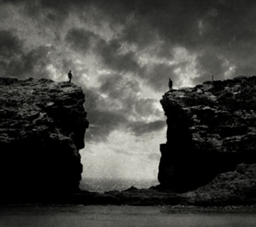
I imagine my research problem as two cliffs with a space in between. One cliff is called Uncertainty and requires asking the question, “what is going on here?” to understand what the source or nature of the certainty is. The second cliff is called Response and describes how uncertainty is responded to. The question that could be associated with this is “what to do?” Both of these first two questions can be identified by deductive analysis according to a current model.
What lies in the space between these two cliffs is more complex and is what I want to find out about. What are the influences on how the response to uncertainty is produced? The question that could be asked here is, “what influences the process to go from uncertainty to response?”
2. Drawings
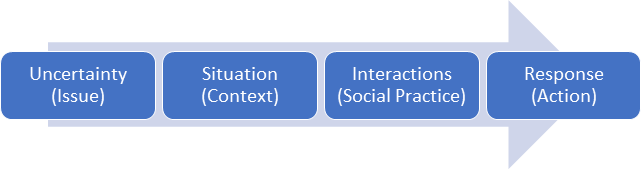
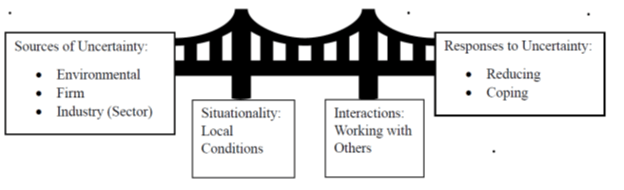
As my drawings tend to be unrecognizable, I used the tools on Word to create the following images. To explain the process of going from uncertainty to response further a flow chart, a bridge, and a narrative description are presented.
The Bridge: A Flow Chart
The Bridge: A Drawing
My “drawing” is not really a drawing but my digitized sketch of what the space between could be composed of.
The Bridge: A Narrative Description
3. Reflection
- The flow chart above expresses my thinking on the human behaviour required to go from uncertainty to response.
- Identifying the issue which is causing uncertainty is a necessary first step. What is going on here? What is the source of this uncertainty? Is it external to the organization and from the surrounding environment? Is it common to other organizations across the sector (industry)? Or, is it from within the firm itself? The central question is ‘what is going on here?’
- Next is understanding the local situation or conditions on the ground. What are the boundaries around the issue from a local perspective? Is it an issue which can be solved locally? What local conditions make it difficult to resolve? What local conditions can help with its resolution?
- What are the interactions with others which will need to be considered to respond to the uncertain issue. Is this a matter for the closely trusted team or for the broader community to be involved in? Should it be discussed only by those internal to the organization or should we go outside to find the response? What process should we follow to conduct the interactions? How will these help find a resolution or will they just get in the way?
- Determining what action to take to either cope with or reduce the level of uncertainty? ‘What to do’ is the central question at this stage. This topic matters to me because from my personal experience and according to John Dewey, uncertainty must be resolved whether from “fair means or foul.” Failing to adequately resolve uncertainty has serious consequences for the organization and for the leader(s) of the firm.
- I like to understand the scope of an issue and the flow of how it will be resolved. Leaving something unresolved is harmful and should be avoided unless all agree that the matter should not be resolved. I can’t stand leaving things alone.
4. Methodologies
I have already chosen qualitative case study as the methodology I will use to understand the organizational narrative and will use Stake’s (2006) book on Multiple Case Study Analysis to guide the study. I see elements of narrative analysis and phenomenology in this as well. Narrative in that I will be telling the story of the individual, rural superintendent as well as that of the entire sector. Phenomenology in that uncertainty provides the research target or “essence” of a situation or issue as (Merriam & Tisdell, 2015) identify it. Case study often contains elements of other research designs according to M & T and it is not surprising that this research will draw from a variety of traditions in providing a complete description of the case.
A final note:
I would like to thank Dr. Fowler and the entire Fall 2023 EDUA 7840 class for the warm welcome and open acceptance of my participation in this class. My doctoral journey has taken me from Shanghai, China to Edmonton, AB and then back to BC (so far). This odyssey now includes Manitoba as another stage of the journey. I was born in Manitoba many (many!) years ago and it was my privilege to be a part of the University of Manitoba even for a short while. Best wishes to our class and the U of M!
谢谢 (Thank you in Mandarin) and Kukwstsétsemc (Thank you in Secwepemctsín)!
 Learn 4 Forever